
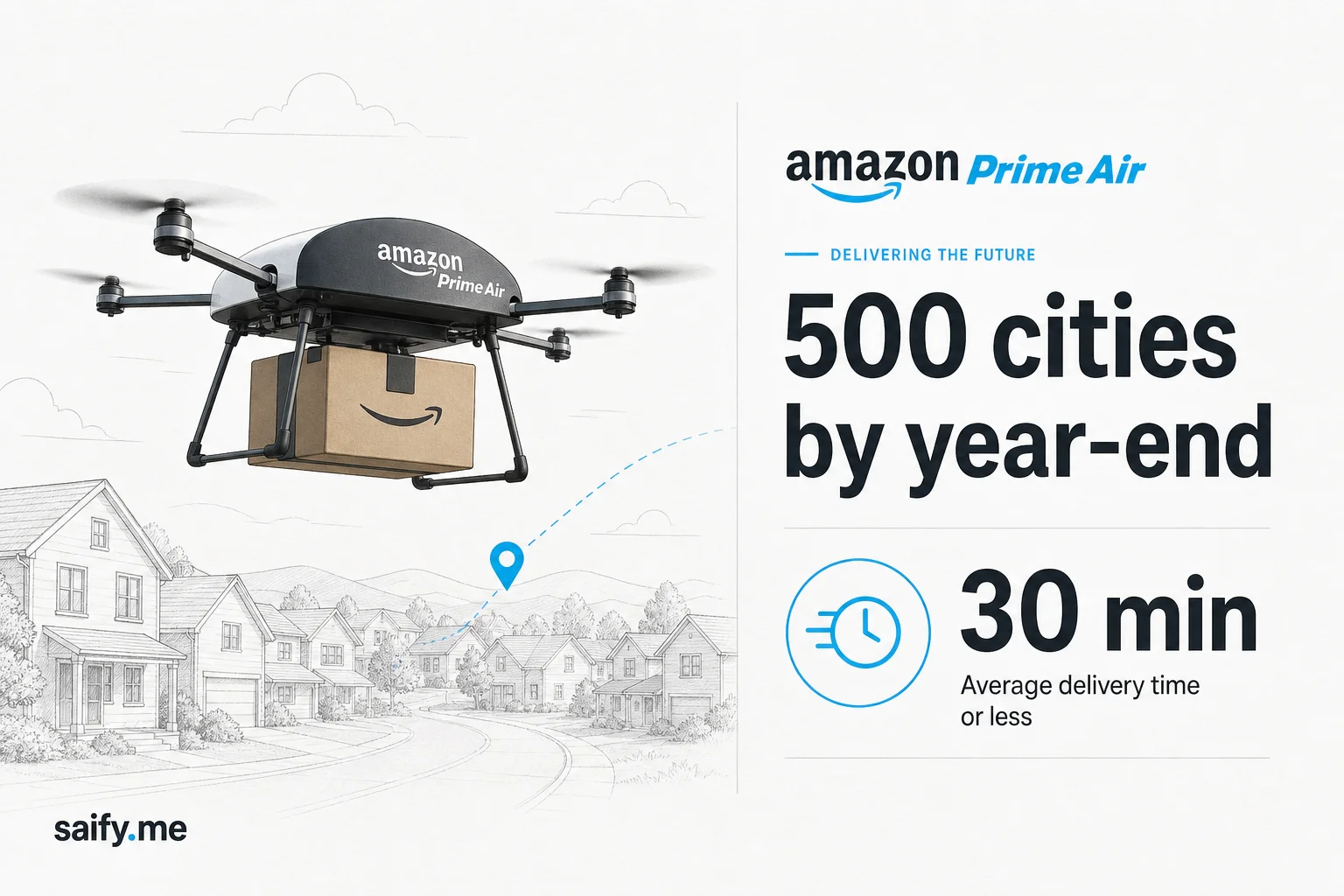
Jeff Bezos showed drones on 60 Minutes in 2013. Thirteen years later, Amazon says Prime Air will hit nearly 500 US cities and towns by the end of 2026, up from 11 active sites today.
I have been skeptical of drone delivery slide decks for a decade. This announcement is the first time the site count, regulatory path, and daily volume line up enough to treat it as an ops problem, not a science fair project.
What Amazon announced

Amazon's official Prime Air expansion post (August 19, 2026)
claims:
- ~6x footprint growth to ~500 locales by year-end
- Tens of millions of customers in range
- Hundreds of thousands of drone deliveries already in 2026, with thousands per day now
- New state launches planned: Georgia, Ohio, Illinois, Idaho, New York (adding to seven states already live)
CNBC reporting on the expansion
tied the public news to an internal March 2026 all-hands where Prime Air VP David Carbon projected 1 million drone deliveries in 2026 and called Amazon the highest-demand drone delivery service in the industry.
| Today (Aug 2026) | Year-end target |
|---|---|
| 11 drone delivery sites | ~500 cities/towns served |
| 7 states live | +GA, OH, IL, ID, NY among expansions |
| Thousands of deliveries/day | 1M deliveries in 2026 (internal goal) |
Hub-and-spoke geometry, not nationwide carpet bombing
Reuters clarified an easy misconception: Amazon is not opening 500 separate drone factories. A single delivery hub can cover multiple towns within ~7.5 miles. Papillion, Nebraska and Ruskin, Florida were named as current examples; Syracuse, Cleveland, Chicago, Atlanta, and Boise were flagged as coming soon.
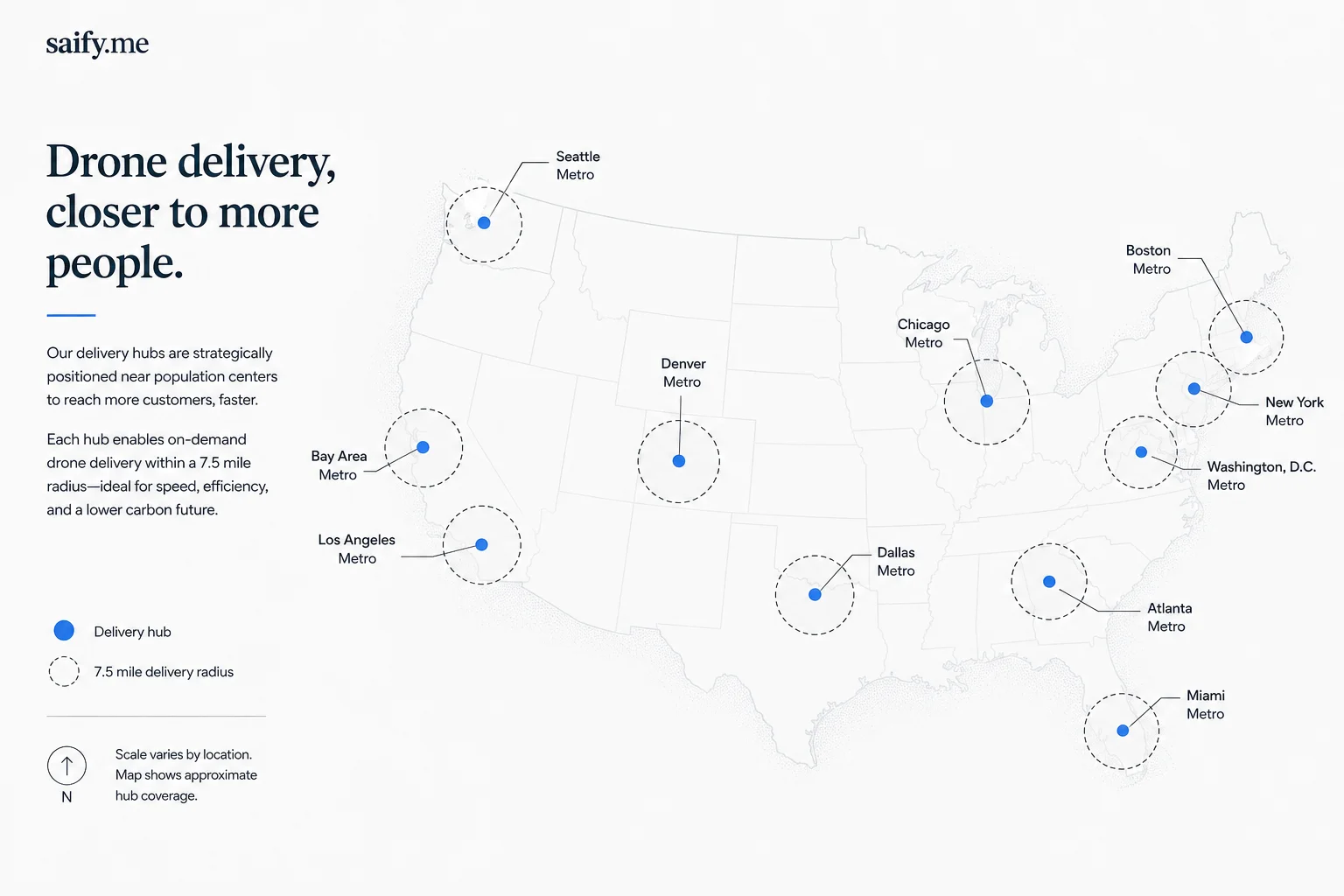
That radius explains why Prime Air skews suburban: you need clearance, detect-and-avoid, and community sign-off. Amazon highlights an industry-leading detect-and-avoid stack in its release. Whether your HOA agrees is still a local politics problem.
Pricing: cheap enough to be a habit, not free by default
Amazon's fee card from the announcement and Reuters:
| Customer | Drone delivery fee |
|---|---|
| Prime member | $2.99 on smaller orders |
| Non-Prime | $4.99 |
| Prime orders $50+ | Free drone delivery (eligible items) |
More than 60% of Amazon's most commonly purchased items are small enough to qualify, per the company. That is the catalog filter that makes 30-minute delivery economically plausible. You are not flying flat-pack furniture.
Competitive context: Walmart already crossed seven figures
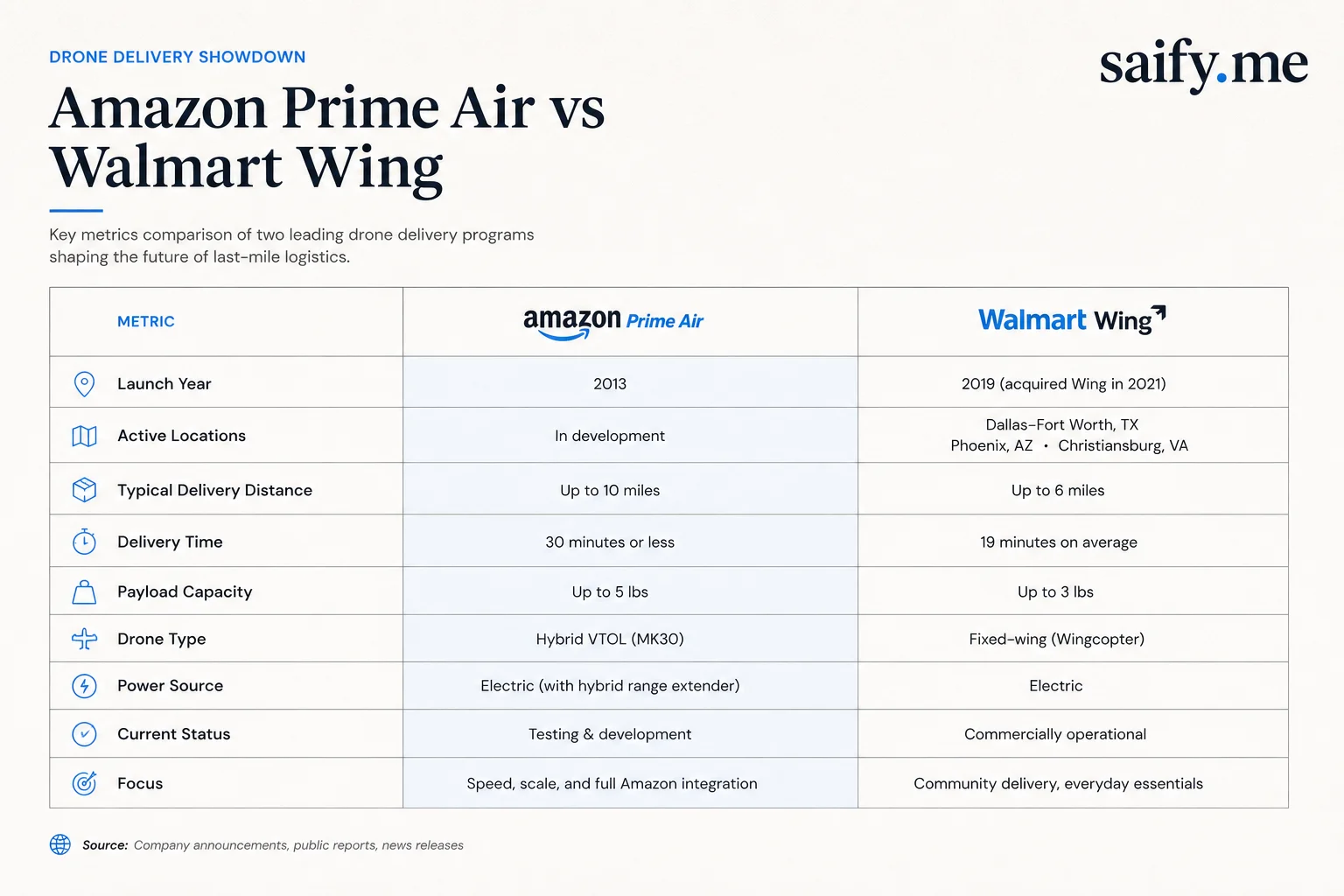
The digest and TechCrunch noted Walmart passed 1 million drone deliveries in May 2026 and was nearing 2 million by July, with its Wing partnership targeting 270+ delivery locations.
| Operator | Scale signal (2026) |
|---|---|
| Amazon Prime Air | Hundreds of thousands YTD; 1M internal target |
| Walmart + Wing | 1M+ deliveries; 40M customers in expansion plan |
| Uber + Zipline | Partnership announced; 1M/day goal by 2029 (digest quick hit) |
Amazon's 500-city headline is partly catch-up, partly leverage: Same-Day and Next-Day rails already exist; drones are the ultrafast wedge when you forgot baby formula at 9 p.m.
Noise, privacy, and the last-mile lesson for AI builders
CNBC reminded readers that residents in early markets still fight noise and privacy concerns. Drone delivery is a logistics API with a public affairs SDK attached.
Why should an applied AI engineer care?
1. Physical automation needs community approval loops. The same town council that hates rotor whine will hate your camera-equipped delivery bot. Bake stakeholder comms into the rollout plan.
2. SKUs determine model choice. Amazon's eligibility filter (size/weight) is analogous to constraining an LLM agent's tool surface. Unlimited catalog = unlimited failure modes.
3. Hybrid stacks win. Prime Air sits beside Amazon Now (30-minute from micro-fulfillment) and traditional Same-Day. Your client stack probably needs voice + CRM + human escalation, not "100% autonomous everything."
4. Metrics that matter are operational. Thousands per day and hub radius tell you if the system works. Vanity demos do not.
What I would watch through Q4 2026
- Site openings vs city count: 500 locales is not 500 hubs; track actual launch cadence in GA, OH, IL, ID, NY.
- 1M delivery goal: Internal projections have missed before in this category.
- Incident reporting: FAA and local news will set the tone for the next 500 approvals.
- Prime uptake on $2.99 tier: Does ultrafast become default, or stay a niche panic button?
The takeaway
Prime Air's 500-city plan is the first credible bridge between Bezos's 2013 demo and a suburban last-mile product: regulated long-range flight, hub economics, real fees, real volume.
For applied AI work, the lesson is not "buy drones." It is that automation at scale is zoning, pricing, and exception handling with a thin layer of clever models on top.
Mapping automation for ops teams that still have humans in the loop? Book a free discovery call and we can sketch where agents, voice, and fulfillment tech actually earn their keep.