
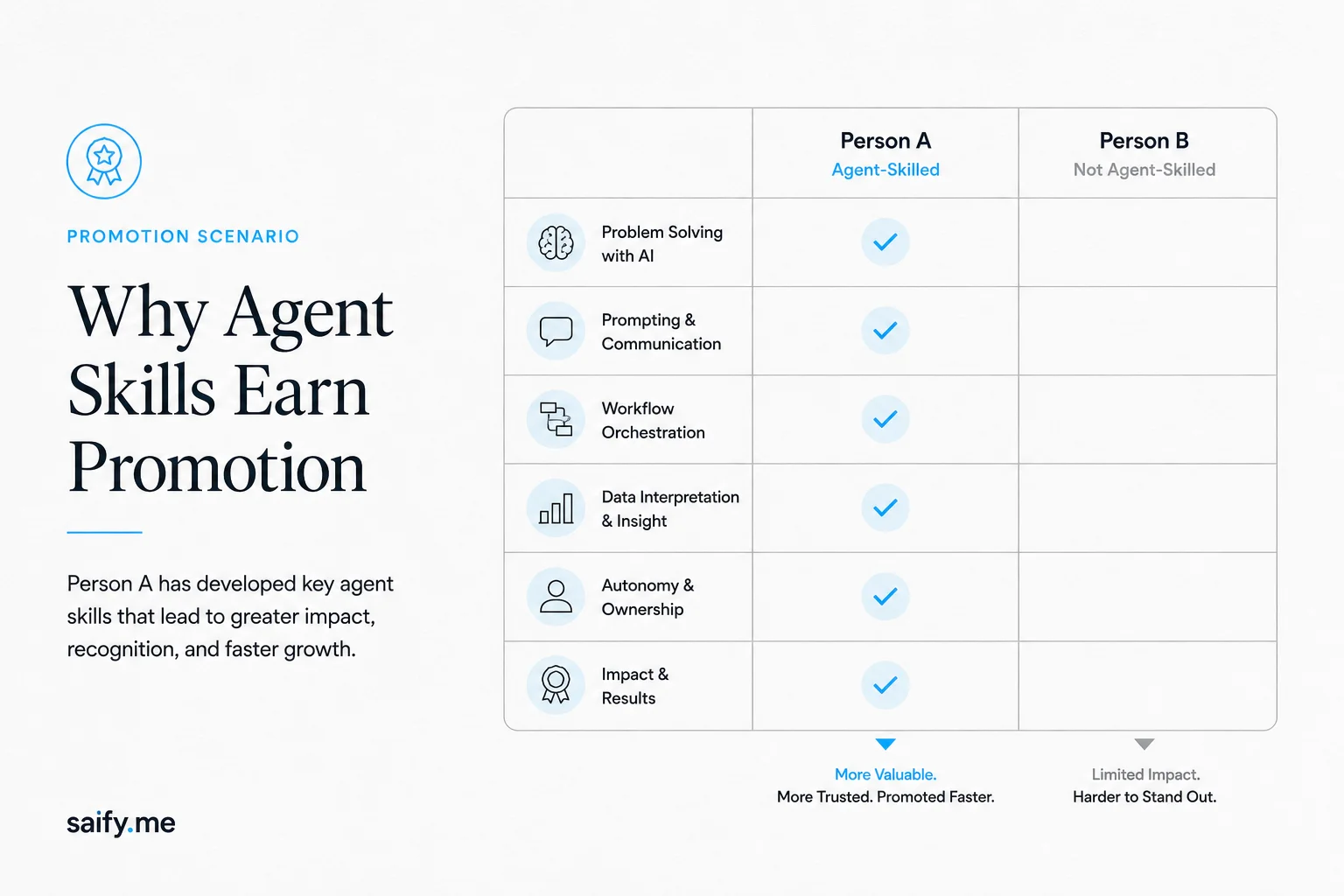
Two candidates have the same résumé. One has shipped a small agent that triages inbound leads overnight. The other uses ChatGPT for email polish. Who gets the promotion?
In a recent simple.ai newsletter, Dharmesh Shah (HubSpot co-founder) made the case that practical agent experience is becoming the differentiator, not generic model access. I build agent workflows for founders and ops teams. The promotion story is simplified, but the direction matches what I see on discovery calls: employers already assume chat fluency. They still reward people who can wire tools into real processes.
The skill gap is narrower than the hype, wider than you think
Dharmesh's framing is useful because it separates two layers:
| Layer | What it looks like | Career signal |
|---|---|---|
| Chat fluency | Prompting, summarizing, drafting | Baseline in 2026 (see Kogod's 42% interview question rate) |
| Agent fluency | Tool use, triggers, multi-step workflows | Still scarce on most teams |
Kogod's three-year business school survey showed interview questions about AI skills jumping from 11.6% in 2024 to 42.6% in 2026. That is chat territory. The candidates who stand out in my client hiring loops can describe what broke when they chained a CRM export to a scoring agent, not which model wrote their cover letter.
Three skills that actually matter
Dharmesh listed three capabilities that map cleanly to client work:
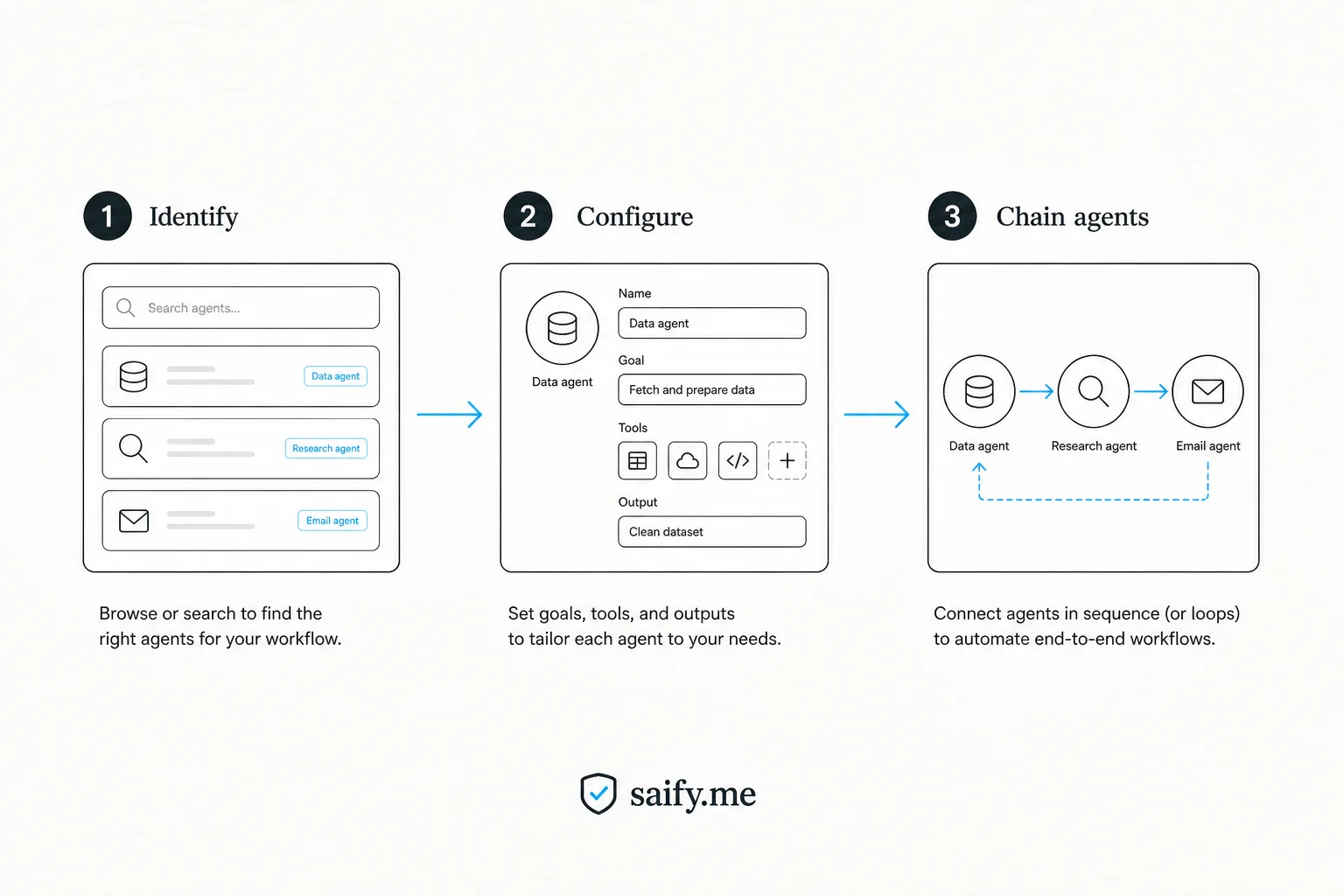
- Spot opportunities where agents add value (and where they do not)
- Configure and customize agents for a specific workflow
- Chain agents to solve multi-step problems
That is the consulting brief I write before anyone touches code. A dental clinic does not need a autonomous research bot. It needs after-hours triage that books into the PMS without hallucinating appointment slots. A SaaS founder does not need twenty MCP servers on day one. They need one agent that enriches inbound leads and writes a Slack summary humans can override.
The low barrier part of his argument holds. You do not need a ML PhD. You need a repetitive task, a builder, and the discipline to measure time saved.
Where agent.ai fits (and where it does not)
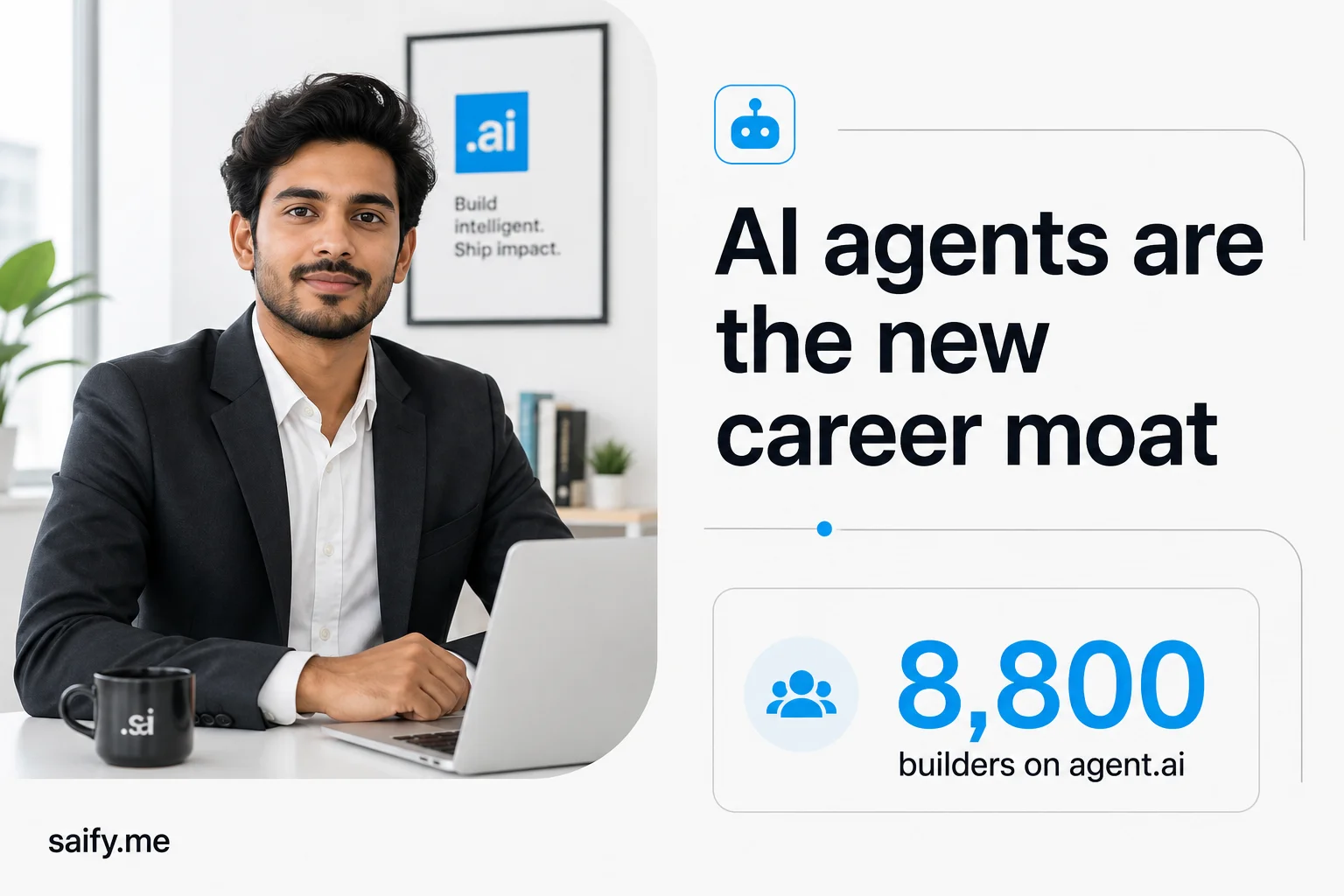
Dharmesh built agent.ai as a no-code agent platform aimed at curious creators, not only enterprise IT. When his newsletter went out, he cited roughly 1.1 million users and 8,800 people who had built their first agent on the platform. The pitch: clone a template, tweak it for your workflow, publish a profile that shows you were early.
That profile idea is underrated. GitHub proves you can code. A public agent portfolio proves you can ship automation without waiting for a formal project assignment. Early movers in inbound marketing got the same compounding benefit Dharmesh describes from the HubSpot era: smaller community, more visibility, sharper intuition before the playbook commoditized.
Fair caveats from the builder side:
- Promo ≠ production. A cloned company-research agent is a great Saturday experiment. Production needs auth, logging, and human review on anything customer-facing.
- Platform landscape shifted. agent.ai also ships HubSpot Agent Builder packs now. If you are already on HubSpot Professional, that path may be faster than learning a net-new UI.
- Verifiable beats theoretical. One agent that saved your team four hours a week beats a profile badge with zero runs.
I still send non-technical operators to no-code builders first. The lesson is not "pick this URL." It is "publish something runnable."
The inbound marketing parallel is the real lesson
Dharmesh compared today's agent moment to early inbound marketing: blogging, SEO, and social before they were table stakes. The people who experimented in 2008 did not need permission. They needed a blog and a bias toward publishing.
Agents are in that window. The builders who document workflows now will look obvious in 2028. The ones who wait for a corporate training program will compete on the same certificates as everyone else.
That matches what I tell clients about agentic AI courses and local-first tools like Claude Code : learn by doing on a real process, then generalize the pattern.
A practical starter plan (no heroics)
Dharmesh's three-step onboarding is sound. Here is how I would run it for a knowledge worker without an engineering background:
1. Start with one annoying task
Pick something you already do weekly: sorting inbound email, prepping a status report, researching prospects before calls. Time it. If it is under 20 minutes, the ROI story is weak unless it is high-stakes.
2. Clone, then constrain
Use a template on agent.ai or a workflow in n8n . Change one variable: your CRM field names, your report headings, your approval step. Add a human checkpoint before anything sends externally.
3. Publish the artifact
Write a short internal doc: problem, agent steps, time before/after, what failed on the first run. That write-up is what hiring managers and promotion committees actually read. The agent is proof.
If you are technical, skip straight to Cursor agents or Claude Code with MCP tools. The career signal is the same: shipped workflow, measured outcome.
What I would not optimize for
- Certificate collecting without a repo or live agent
- Auto-apply job bots that spray applications (see why I prefer drafter-reviewer patterns in ai-job-search instead)
- Agents on sensitive data before you have secrets management (I wrote about vaults vs
.envfiles here for a reason)
The moat is judgment, not access
Everyone has model access in 2026. The moat is knowing which workflows deserve autonomy, where to keep humans in the loop, and how to show receipts.
Dharmesh is selling a platform, but the career advice underneath is right: a small investment of time now compounds like early inbound skills did. Pick one boring task, ship one agent, document the result. Your future reviewer will not care which builder you used. They will care that you moved before the playbook was printed.
If you want help scoping a first agent for ops or product, book a free discovery call. I will tell you honestly if a spreadsheet still wins.