
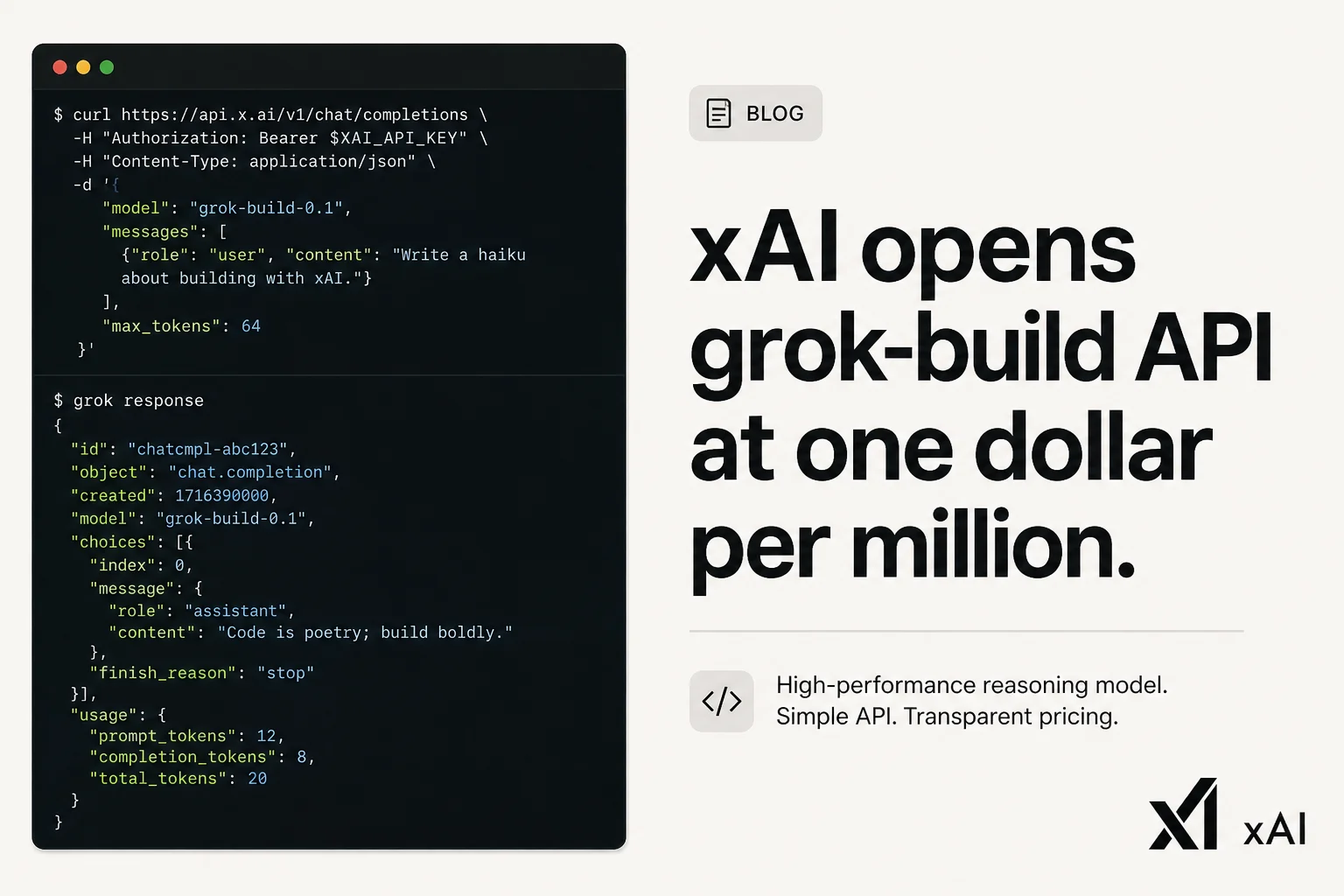
Most coding models are tuned for chat completions. grok-build-0.1 is tuned for loops: plan, edit, run tools, read stderr, patch again.
On May 29, 2026, xAI put that model on the public API. Until then, Grok Build lived behind subscriber CLI access. Opening the API changes who can embed it: IDEs, CI pipelines, custom agent frameworks, and orchestration platforms that treat coding models as primitives.
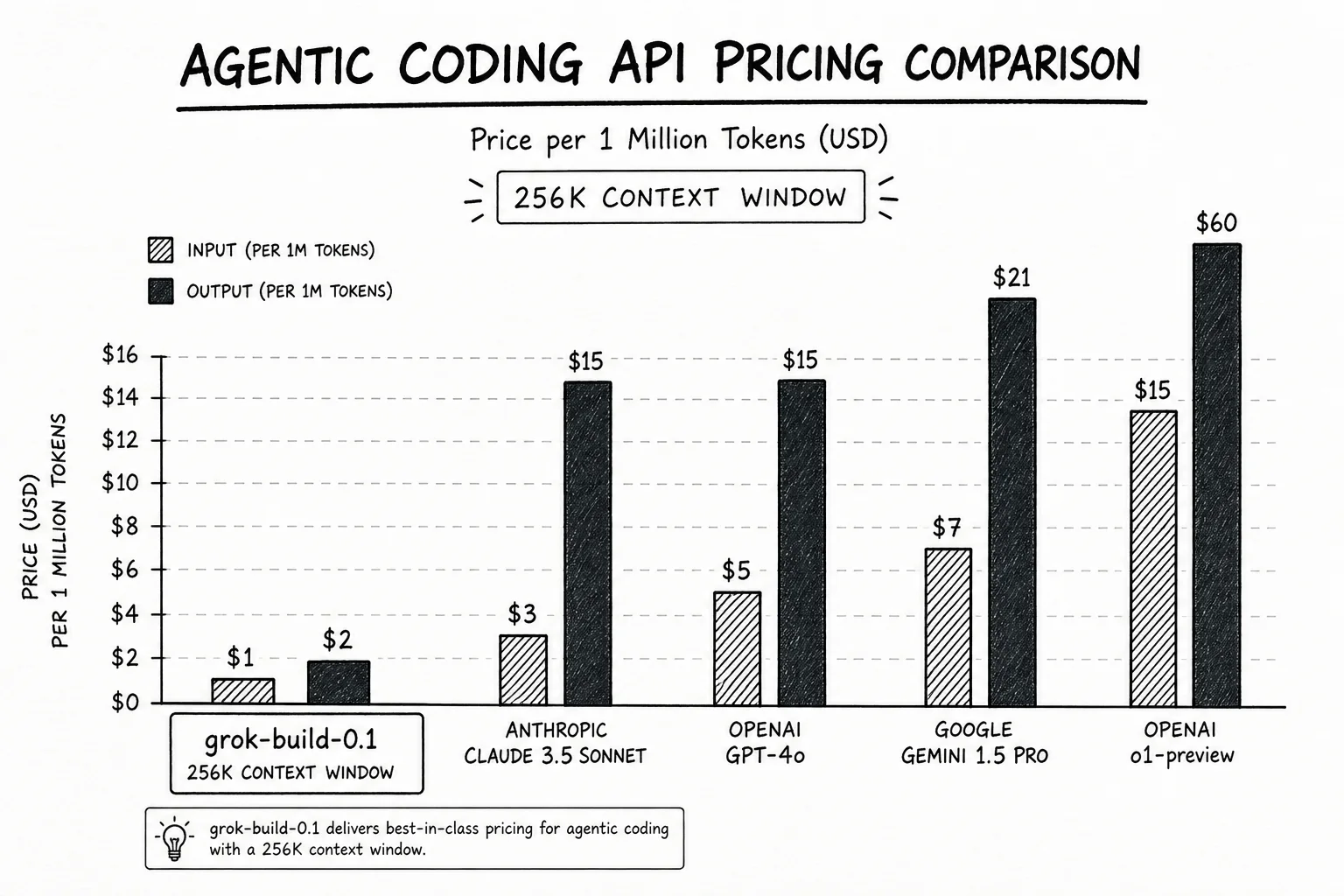
xAI's grok-build-0.1 announcement positions it as the same model behind Grok Build, served at 100+ tokens per second, with list pricing at $1 per million input tokens and $2 per million output tokens (under 200K prompt tokens). Cached input drops to $0.20 per million.
That price point is not subtle. It sits in the same conversation as specialized coding economics and the May 2026 wave of workhorse models that challenge frontier-only routing.
Spec sheet that matters for harness builders
| Capability | grok-build-0.1 |
|---|---|
| Context window | 256,000 tokens |
| Modalities | Text and image in, text out |
| Function calling | Yes |
| Structured outputs | Yes |
| Reasoning | Always on |
| Model aliases | grok-code-fast-1, grok-code-fast, grok-code-fast-1-0825 |
| Batch API | Not supported (as of docs) |
The 256K window is the headline for mid-sized repos. Loading a whole service tree into one agent pass without aggressive truncation changes planning behavior. You still pay for what you read, but you are less likely to silently drop files off the context cliff.
Image input matters for agent loops that start from screenshots: failing UI states, mockups, or error dialogs pasted into the thread. That is increasingly how non-IDE agents get repro steps from operators who do not write perfect prompts.
xAI model docs also note higher per-token rates when prompts exceed 200K tokens. Long-context agents should watch prompt growth, not just output spend.
Pricing in context (not in isolation)
List price is a starting point. Agent harnesses care about cost per finished task.
| Model class | Typical list posture (May 2026) | Harness note |
|---|---|---|
| grok-build-0.1 | $1 / $2 per M tokens (in/out, <200K prompt) | Built for agentic coding + MCP |
| Composer 2.5 standard | $0.50 / $2.50 per M tokens | Strong Cursor harness integration |
| Frontier Opus / GPT-5.5 class | $5+ / $25+ per M tokens | Higher cost per task on agent indexes |
Artificial Analysis still shows frontier models leading some agent indexes while specialized tiers win on dollars per task. grok-build enters that market as another execution-tier candidate, not as a replacement for every frontier escalation path.
My rule: benchmark three models in your repo with your tools before you change routing tables. Public benchmarks tell you who is competitive. Your harness tells you who finishes.
API access and integration paths
xAI ships a straightforward REST entry point:
curl https://api.x.ai/v1/responses \
  -H "Content-Type: application/json" \
  -H "Authorization: Bearer $XAI_API_KEY" \
  -d '{
    "model": "grok-build-0.1",
    "input": [
      {
        "role": "user",
        "content": "Find the bug in this React form validation handler"
      }
    ]
  }'
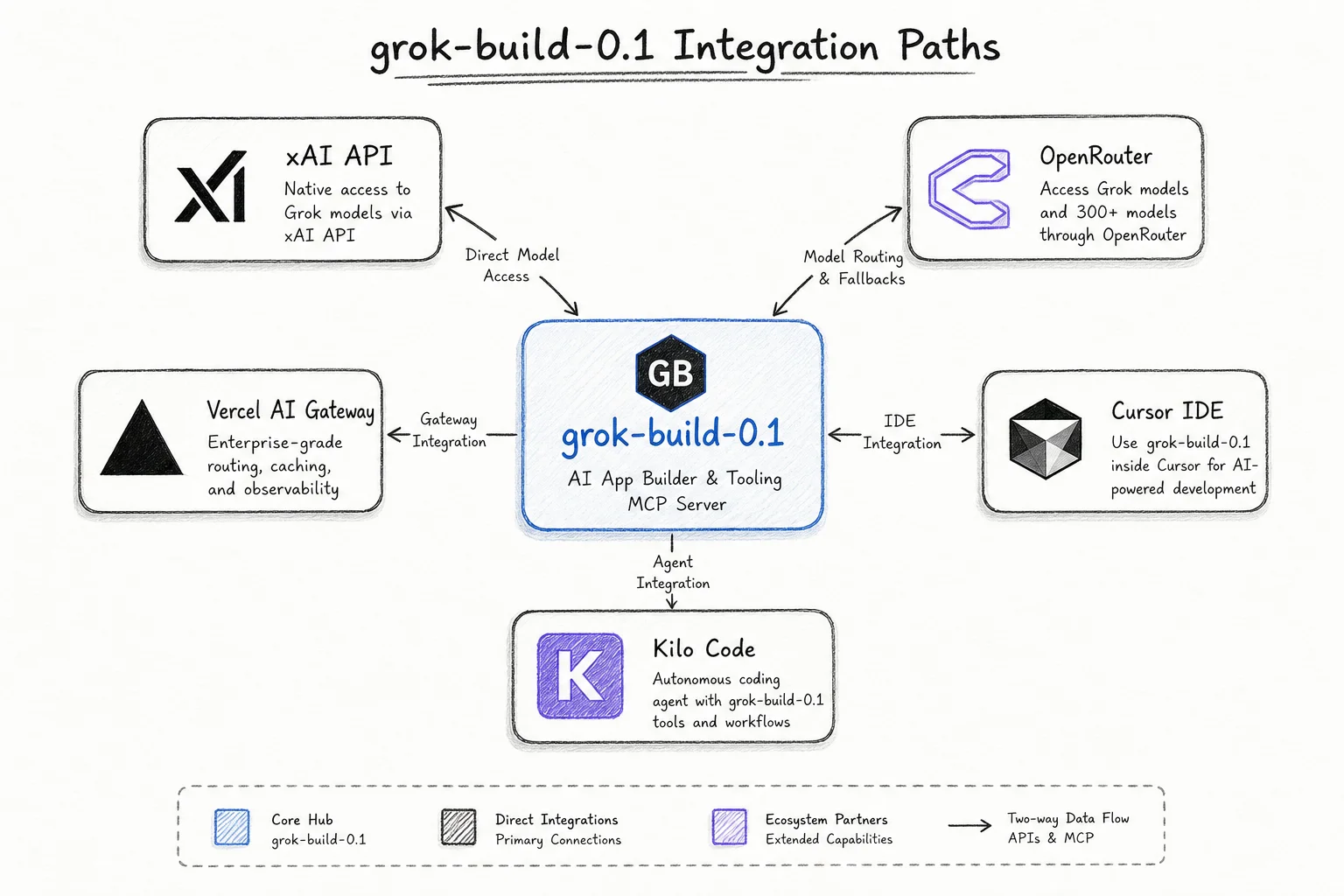
Beyond direct API calls, xAI lists harness partners where the model "performs best":
- Cursor
- Grok Build CLI
- Hermes Agent
- OpenClaw
- Kilo Code
- OpenCode
Distribution also includes OpenRouter and Vercel AI Gateway for teams that centralize model routing behind one billing surface.
DevOps.com framed the API launch as removing the subscription wall around Grok Build. That matters for ACP-style orchestration: platforms that call Claude Code, Codex CLI, or Grok Build as interchangeable worker primitives.
What "agentic coding model" means here
The digest language ("coding collaborator that keeps going") maps to concrete training targets:
| Behavior | Why harnesses care |
|---|---|
| Multi-step planning | Fewer human nudges per feature |
| Tool invocation | Shell, MCP, fetch, patch tools without hand-holding |
| Refactor across files | Repo-scale edits, not single-file snippets |
| Debug loops | Read errors, hypothesize, retry |
xAI claims 100+ tokens per second throughput. For interactive agents, latency shapes how "autonomous" the loop feels. A slow model that is smart on paper still gets interrupted by humans who click stop.
Public beta status means rough edges are expected. Treat early adoption as eval infrastructure, not as a forced migration off your current default.
Routing grok-build next to models you already use
I would not rip out Composer or Sonnet-class defaults on day one. I would add grok-build as a candidate execution tier behind the same router.
Practical split:
| Tier | Share of turns | Examples |
|---|---|---|
| Execution | 70 to 85% | grok-build-0.1, Composer 2.5, fast Sonnet-class |
| Planning / escalation | 15 to 30% | Opus, GPT-5.5 xhigh, deep research passes |
Escalation triggers I actually encode in projects:
- Two failed test runs on the same hypothesis
- Security-sensitive diffs touching auth or payments
- Novel architecture with no local examples in the repo
- Tool errors that indicate missing context, not bad patches
Agentic coding model routing in 2026 goes deeper on cost-per-task math. grok-build is another line on that spreadsheet, not a philosophy change.
MCP and image input in production agents
MCP support is the integration story for teams building internal agent platforms. If your orchestrator already speaks MCP, swapping model endpoints is cheaper than swapping harnesses.
Image input is the integration story for ops agents and support agents where repro steps arrive as screenshots. Coding agents in IDE surfaces benefit too when designers paste UI mocks into the same thread as implementation tasks.
Watch token growth when images stack across turns. Vision tokens are not free even when list price looks friendly.
Checklist before you add grok-build to routing
- Clone your standard agent eval (10 to 20 real tasks from last sprint).
- Run grok-build in the same harness as your current default (Cursor, custom CLI, CI agent).
- Log cost per completed task, not just wall time.
- Measure escalation rate to frontier models when grok-build stalls.
- Re-run monthly while the model is in public beta.
Takeaway
grok-build-0.1 is xAI's bid to make agentic coding a programmable API primitive at workhorse prices. The 256K context, tool use, and image input line up with how real harnesses run today. Public beta means you should benchmark, not declare victory from a press release.
If you want help designing a multi-model routing layer (evals, escalation policy, and finance-friendly logging), book a free discovery call.