
Every RAG pipeline I've audited eventually hits the same wall: the PDF parser.
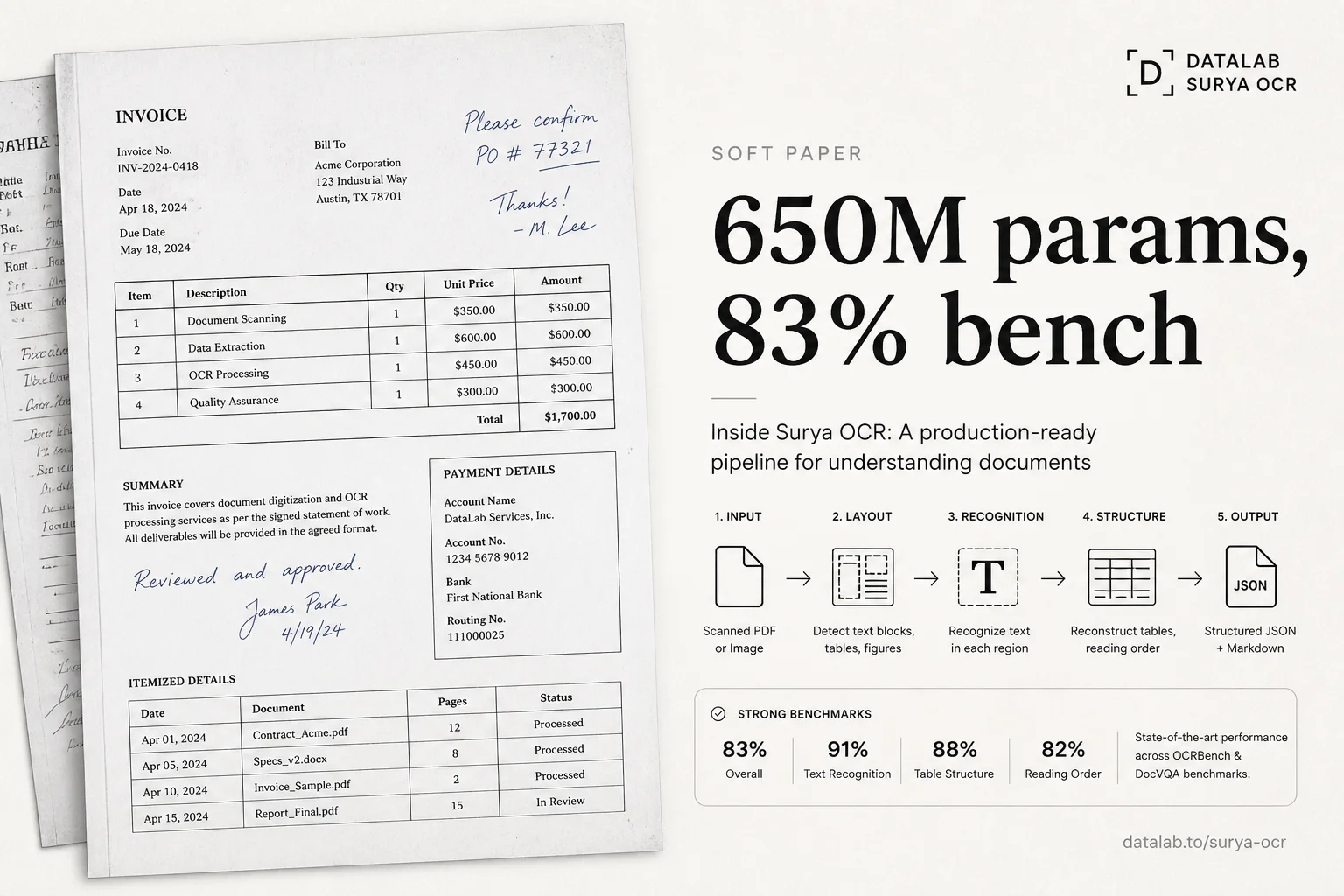
Scanned contracts, handwritten intake forms, tables that collapse into word soup. Teams either pay per-page API fees or duct-tape five specialized models together. Datalab's answer in May 2026 was blunt: rebuild Surya as a single 650M vision-language model and ship state-of-the-art numbers at sub-3B scale.
What Surya OCR 2 actually does
Surya 2 is a ground-up rework. One 650M-parameter VLM (Qwen3.5-style architecture) handles:
- Full-page OCR
- Layout analysis (headers, images, tables)
- Reading order
- Table recognition (rows and columns)
Text-line detection stays a separate lightweight EfficientViT model. Layout, OCR, and table tasks share the same VLM weights.
Datalab: Announcing Surya OCR 2Outputs moved from v1's text_lines to structured blocks with HTML, bounding boxes, and inline LaTeX for math. That's a breaking API change. Budget migration time if you're on Surya 1.x.
The benchmark that matters
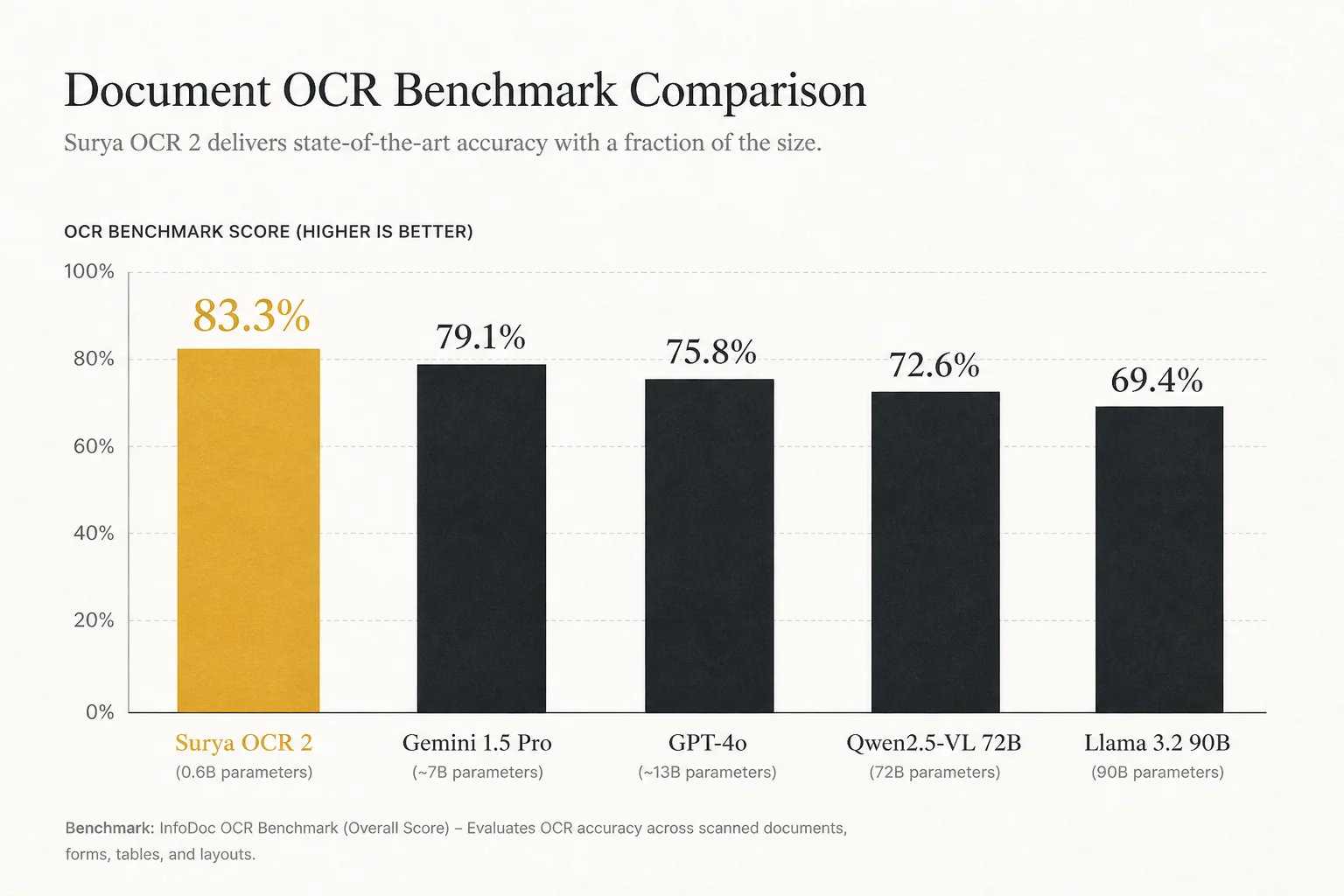
On olmOCR-bench, Surya 2 hits 83.3%. Best score under 3B parameters. For context:
| Model | Params | olmOCR-bench |
|---|---|---|
| Infinity-Parser2-Pro | 35.1B | 87.6 |
| Chandra OCR 2 (Datalab) | 4.0B | 85.9 |
| dots.mocr | 3.0B | 83.9 |
| Surya OCR 2 | 0.65B | 83.3 |
| olmOCR (anchored) | 8.3B | 77.4 |
| GOT OCR | 0.6B | 48.3 |
You're within ~4 points of models 54x larger. For private document pipelines, that gap often loses to latency and hosting cost.
Multilingual coverage is the other headline: 87.2% average across 91 languages on Datalab's internal eval, with 38 languages at or above 90%.
Speed and where it runs
Datalab reports 5.35 pages/sec on a single RTX 5090 at 128 concurrent requests. Apple Silicon is viable through llama.cpp at roughly 0.1 pages/sec in community reports. Slow for batch OCR farms. Fine for laptop-side prototyping.
Inference backends:
- vLLM + Docker + NVIDIA Container Toolkit on GPU
- llama.cpp on CPU or Apple Silicon
pip install surya-ocr
v2 API sketch:
from surya.inference import SuryaInferenceManager
from surya.recognition import RecognitionPredictor

manager = SuryaInferenceManager()  # auto-spawns vllm or llama-server
rec = RecognitionPredictor(manager)
predictions = rec([image])
Licensing (read before production)
- Code: Apache 2.0
- Weights: modified OpenRAIL-M (free for research, personal use, startups under $5M funding/revenue)
Broader commercial weight licensing goes through Datalab's pricing page. Don't assume Apache 2.0 covers the checkpoint.
When I'd pick Surya 2 over a cloud API
Good fits:
- On-prem or VPC-bound documents (health, legal, finance)
- Multilingual intake without per-language model sprawl
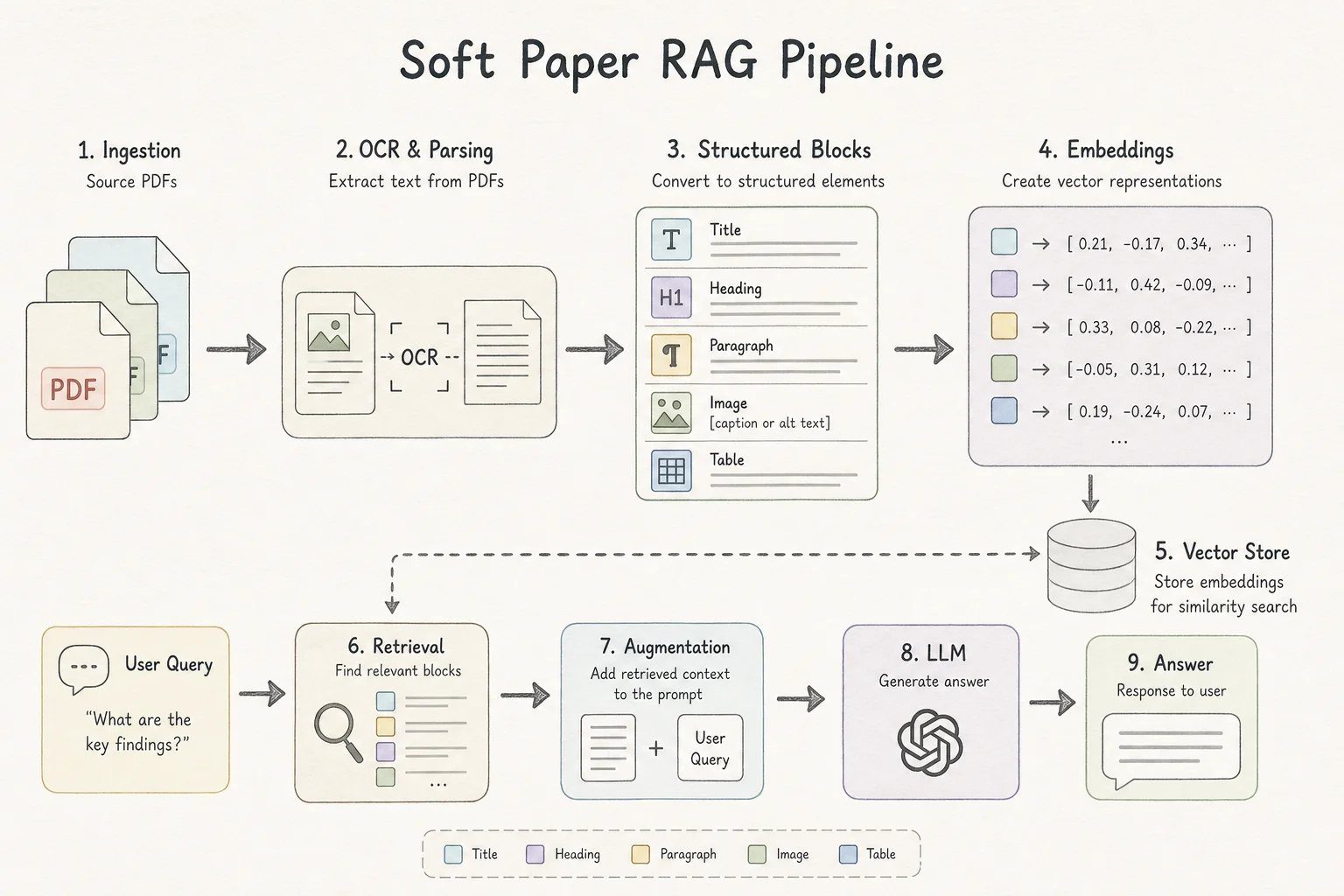
- RAG prep where layout and tables must survive chunking
- Cost-sensitive batch jobs where 650M local beats per-page SaaS
Stick with cloud parsers when:
- You need managed SLAs and zero GPU ops
- Documents are mostly clean digital PDFs (cheaper text extraction may suffice)
- Compliance requires a vendor's BAA/DPA today, not next quarter
Integration tips from client work
- Chunk on block boundaries, not arbitrary token windows. Tables die when you split mid-row.
- Store HTML + bbox metadata for citation UIs. Users trust answers that highlight source regions.
- Benchmark on your docs, not leaderboard PDFs. Handwriting and stamp noise vary wildly by industry.
- Plan v1 → v2 migration if you cached Surya 1 outputs. Schema changes are real.
Try without installing via the Datalab playground.
Bottom line
Surya OCR 2 is the strongest argument I've seen this year for small specialist VLMs beating "throw a 7B generalist at it." If document parsing is on your critical path, run it on a sample of production PDFs before the next invoice from your cloud OCR vendor.
Need help wiring OCR into a private RAG or ops workflow? Book a free call.