
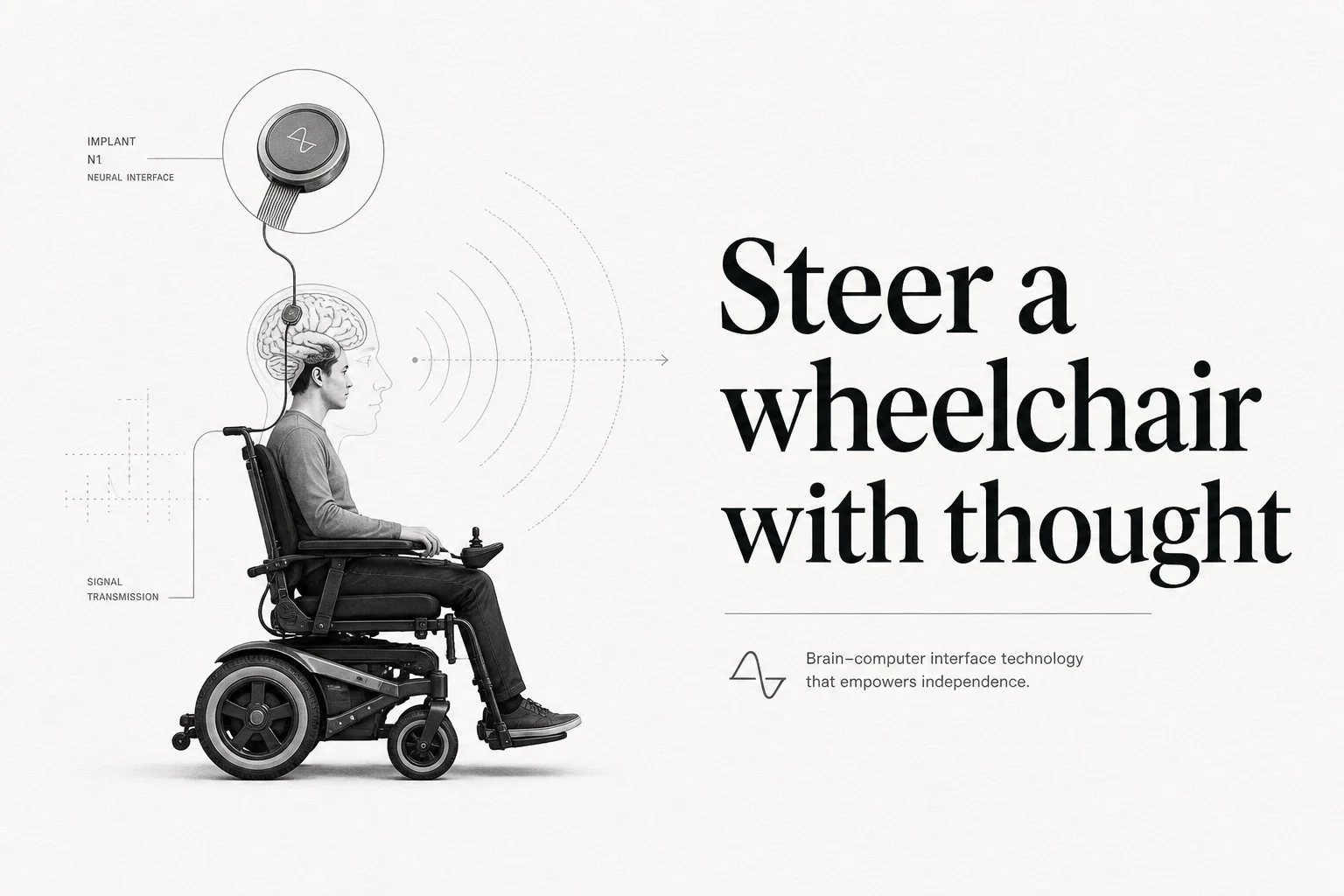
A quadriplegic trial participant rolls through a room with no joystick in hand and no head controller straining his neck. He imagines moving. The wheelchair obeys.
Neuralink published footage in July 2026 showing clinical trial participants steering powered wheelchairs through decoded motor intent. Cursor control on a laptop was already impressive. Wheelchair control is the same decoding stack pointed at hardware that changes where a human body can go.
I build applied AI systems for ops and product teams. BCI demos rarely show up in my client Slack. Still, this one is worth studying because the architecture is familiar: streaming signals, per-user ML calibration, safety guardrails, and a UI layer that keeps humans in the loop.
From cursor to chair: the control stack
The N1 implant sits in the motor cortex, the region that plans voluntary movement. More than 1,000 electrodes on flexible threads record neural spikes when a participant imagines motion, even if the body cannot execute it.
A machine learning model maps those spike patterns to a 2D cursor. That cursor becomes a virtual joystick. Custom electronics translate joystick coordinates into analog drive signals a standard powered wheelchair already understands.
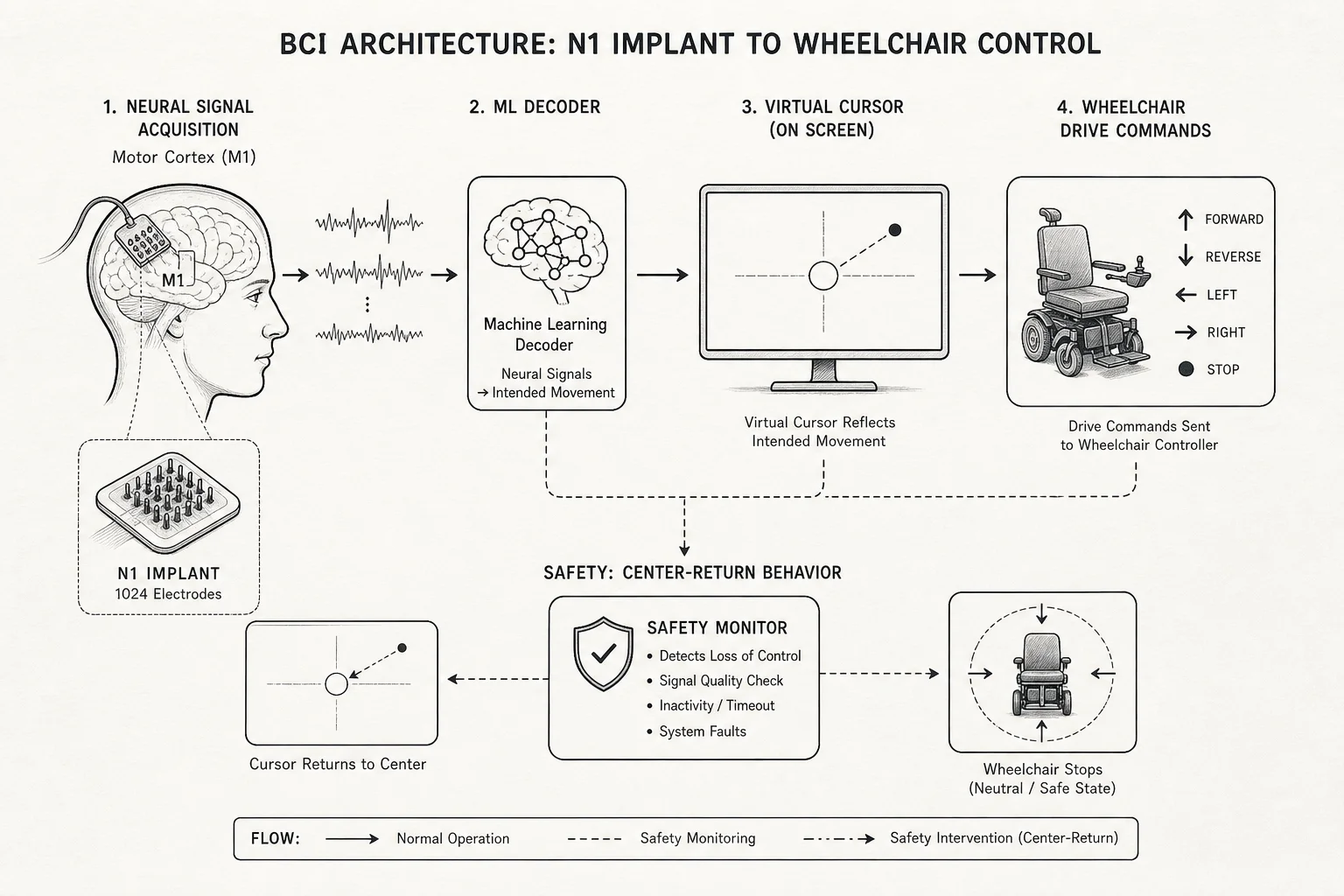
Neuralink built a dedicated wheelchair app with a live camera feed so participants can see what is in front of the chair while they steer. Push the cursor toward the top of the ring and the chair creeps forward. Push farther and speed increases. Release focus and the cursor drifts back to center, slowing the chair.
That center-return behavior is not a nice-to-have. If a user loses concentration or becomes incapacitated, the chair should not keep accelerating into a wall.
What participants actually report
Marketing clips are polished. Participant quotes in the demo and in coverage from Interesting Engineering add texture.
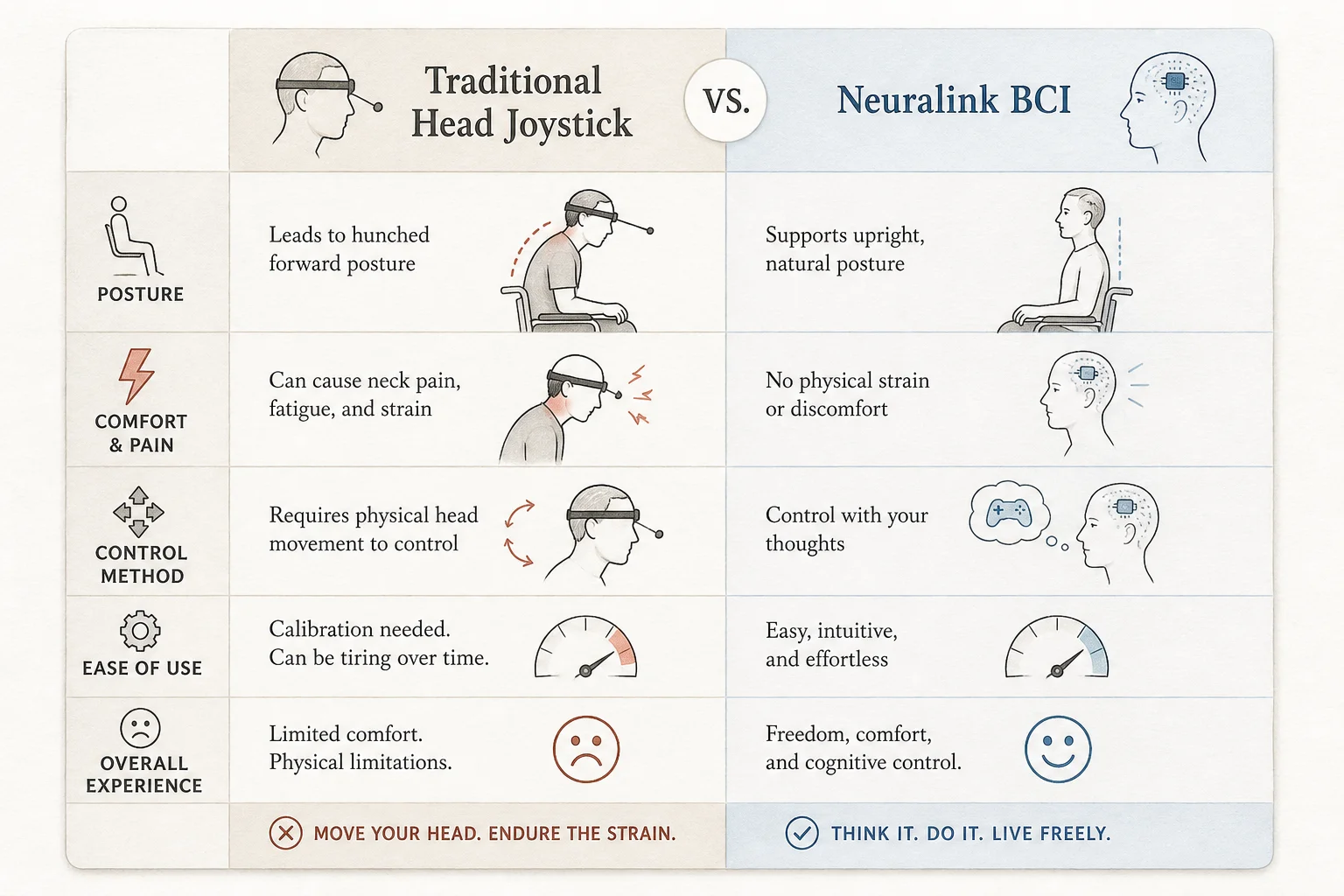
Early sessions felt "stop and go." After a few minutes, control became more natural. One participant contrasted head-operated joysticks, which force a hunched posture and cause pain, with BCI driving that let him sit upright comfortably.
That ergonomic detail matters for product design. Independence is not only "can they move." It is "can they move without trading one form of suffering for another."
Trial context and regulatory reality
Neuralink frames the work inside the PRIME study (Precise Robotically Implanted Brain-Computer Interface). The trial targets people with quadriplegia from spinal cord injury or ALS.
| Milestone | Status (mid-2026 reporting) |
|---|---|
| FDA approval for N1 implant | Not granted; device is investigational |
| Global trial enrollment | Roughly 21 to 26 participants across multiple countries |
| Primary trial completion (projected) | Around 2026 |
| Full study conclusion (projected) | Around 2031 |
| Peer-reviewed wheelchair results | Demo footage and company statements; limited outside scrutiny so far |
Neuralink posts voluntary participant experiences. Those stories are real for the people shown, but they are not a statistical summary of every enrollee.
If you evaluate neurotech like you evaluate enterprise AI pilots, treat the demo as a technical milestone inside a long regulatory runway, not as a product you can order.
Why the virtual joystick pattern is smart engineering
Directly mapping raw motor cortex activity to wheel torque on four motors sounds heroic and fragile. The cursor intermediary adds a layer humans already understand from earlier Neuralink cursor tasks.
Benefits I see as an applied engineer:
-
Reuse calibrated decoders. Same spike-to-cursor model can target different endpoints (screen, robotic arm, wheelchair) with new output mapping logic.
-
Visual grounding. Live camera feed plus on-screen cursor gives spatial context for navigation decisions in real rooms, not abstract grid worlds.
-
Graceful degradation. Center-return and speed rings encode safety without a separate emergency stop pathway for every failure mode.
-
Hardware agnosticism. Translating to analog signals a standard wheelchair accepts means the BCI layer does not need to own motor controller firmware for every chair vendor.
This is the same lesson I preach on voice agents: do not wire the model directly to irreversible side effects. Put a bounded interface in between.
Data, privacy, and the hard questions
1,024 electrodes produce rich neural datasets. Per-user calibration means the model learns idiosyncratic patterns that are also deeply personal biometrics.
Open questions that serious observers keep raising:
- Long-term tissue response around flexible threads
- Who owns neural recordings and derived models
- Corporate control over firmware updates that change decoding behavior
- Reproducibility outside company-run trials
Academic BCI labs have pursued similar goals for decades. Neuralink's contribution is surgical robotics at scale, consumer-grade wireless implants, and demo velocity. The science policy questions are not new, but the corporate surface area is larger.
Parallels for applied AI builders
You may never implant a chip. The control patterns still transfer.
| BCI component | Ops / product AI analog |
|---|---|
| Per-user decoder calibration | Few-shot personalization on enterprise data |
| Streaming spike inference | Real-time event pipelines with sub-second budgets |
| Virtual joystick safety layer | Human-in-the-loop approvals before CRM writes |
| Camera feed UI | Ground truth context panels for agent decisions |
| Investigational disclaimers | Staging labels and feature flags before GA |
When I wire voice agents that book appointments or update CRM records, I use the same hierarchy: sense intent, map to a bounded action space, show the user what will happen, and default to safe idle states on ambiguity.
What comes next on the mobility path
Neuralink positions wheelchair control as an early step toward broader mobility restoration. Company messaging mentions expanding from digital interfaces to robotic arms and other assistive hardware.
Wheelchairs are a demanding test because errors have physical consequences. If decoding stays stable enough for room navigation, the same stack might extend to finer manipulators. Each new endpoint reuses cursor decoding and swaps output mapping.
For people with severe paralysis, the bar is not "cool demo." It is hours per day of reliable control without injury.
My takeaway
July 2026 gave us video proof that motor intent decoded from intracortical recordings can drive a powered wheelchair through a mapped virtual interface, with participant reports of improving comfort versus head controllers.
That is applied ML leaving the laptop screen. It is also still inside clinical trials with no FDA approval and a decade-long study horizon.
If you are building real-time inference systems, safety-bounded action layers, or per-user model calibration in production, this demo is a useful reference architecture. If you need help designing similar sense-decode-act loops for business automation (with far lower stakes than brain surgery), that is the work I do day to day.
Book a free discovery call to map where streaming ML, guardrails, and human-in-the-loop UI should sit in your stack.