
Enterprise Claude adoption used to mean two procurement tracks: Anthropic direct and Azure for everything else. That split added legal review, identity sprawl, and finance teams asking why Claude spend does not hit the MACC.
As of late June 2026, Claude Opus 4.8 and Haiku 4.5 are generally available in Microsoft Foundry on Azure with native billing, Entra ID, and prompt caching. One invoice line. One identity plane.
What changed for builders
| Capability | Hosted on Azure (GA) | Hosted on Anthropic |
|---|---|---|
| Opus 4.8 | Yes | Yes |
| Haiku 4.5 | Yes | Yes |
| Prompt caching | Yes | Yes |
| Extended thinking | Yes | Yes |
| Tool streaming | Yes | Yes |
| Entra ID + Azure RBAC | Yes | No |
| US Data Zone residency | Yes | Different path |
The Azure model catalog lists Version 2 with tool use, structured outputs, web search, web fetch, MCP connector, and tool search on the hosted path.
For regulated teams, data residency was often the blocker to Claude on direct API. Hosted-on-Azure gives a Global Standard or US Data Zone choice with inference processing on Azure infrastructure.
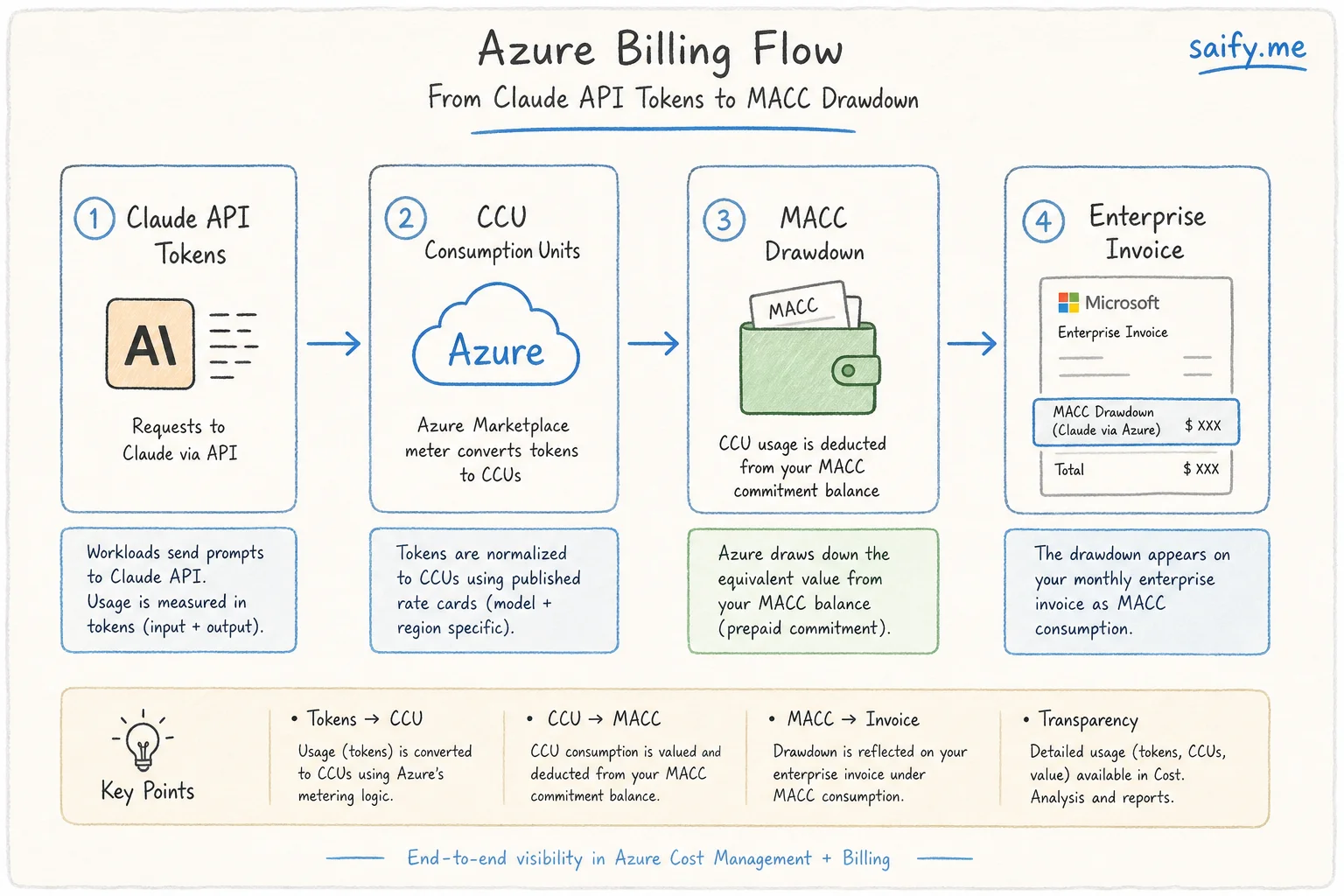
Billing: CCUs on your Azure invoice
Foundry bills through the Azure Marketplace in Claude Consumption Units (CCUs):
- 100 CCU = $1.00 USD of Claude usage at standard API rates
- Hourly metering, monthly invoice on your Azure bill
- Postpaid only (no prepaid CCU balance)
- MACC eligible for Enterprise Agreement customers
Per-model token rates match Anthropic's public pricing. Opus 4.8 lists at $5/MTok input and $25/MTok output before CCU conversion.
Prompt caching multipliers apply the same way as direct API:
| Cache event | Multiplier (typical) |
|---|---|
| 5-minute cache write | 1.25x input |
| 1-hour cache write | 2x input |
| Cache hit | 0.1x input |
Batch API (50% discount) is available for async workloads. Fast mode availability should be checked per deployment type in current docs.
Prompt caching on Foundry: what to configure
Caching is not automatic because you deployed on Azure. You still need:
- Prompts above the minimum token threshold (1,024 tokens for Opus 4.8 in standard docs)
- Explicit
cache_controlbreakpoints in Messages API requests - Stable prefix content across turns (system prompt, tool definitions, long docs)
I treat Foundry caching the same as direct API caching for cost models. The savings show up in CCU metering, not a separate Anthropic dashboard.
If you run agent loops with fat system prompts and tool schemas, caching is often the difference between "pilot affordable" and "finance asks questions."
Identity and governance wins
The practical enterprise wins are boring and valuable:
- Microsoft Entra ID authentication instead of parallel API key vaults
- Azure RBAC on who can deploy which model SKU
- Consolidated invoice for FinOps teams already living in Azure Cost Management
- Optional zero data retention for high-sensitivity workloads (Anthropic does not retain prompts/outputs after completion when enabled)
Teams building agents for healthcare, finance, or government often already standardized on Azure. This removes "exception vendor" status for Claude.
SDK and integration notes
Anthropic's client SDKs (Python, TypeScript, Java, C#, PHP) work against Foundry endpoints with Azure auth configuration. Go and Ruby are not listed as supported today.
Default deployment names include claude-opus-4-8 and claude-haiku-4-5. Check the Foundry setup guide for resource creation and endpoint URLs.
Free trial, student, and sponsored Azure subscriptions are not supported for Claude marketplace billing per launch notes.
How I would roll this out
- Pilot on Haiku 4.5 for high-volume classification or routing before Opus spend.
- Enable caching on agent system prompts and RAG context blocks first (largest repeated prefixes).
- Pick US Data Zone only if compliance requires it; otherwise benchmark latency on Global Standard.
- Map MACC drawdown with finance before Opus workloads scale.
- Keep a direct API path for features still hosted-only on Anthropic if you need parity.
Risks to plan for
- Feature parity lag between hosted-on-Azure and hosted-on-Anthropic paths may persist for new capabilities.
- CCU accounting is unfamiliar to teams used to raw token dashboards. Build a small cost attribution layer early.
- Caching misuse (breaking prefixes every turn) wastes write costs without hits.
- Regional SKU availability can block a rollout if your subscription type is excluded.
Bottom line
Claude Opus 4.8 on Azure is not just another model listing. It is Claude inside the procurement and identity system enterprises already run.
Native billing plus prompt caching means you can model agent costs the same way you model Azure compute. For teams that were waiting on residency or MACC eligibility, this is the green light.
If you need help designing cached agent architectures or Azure-native Claude deployments for production, book a free discovery call.