
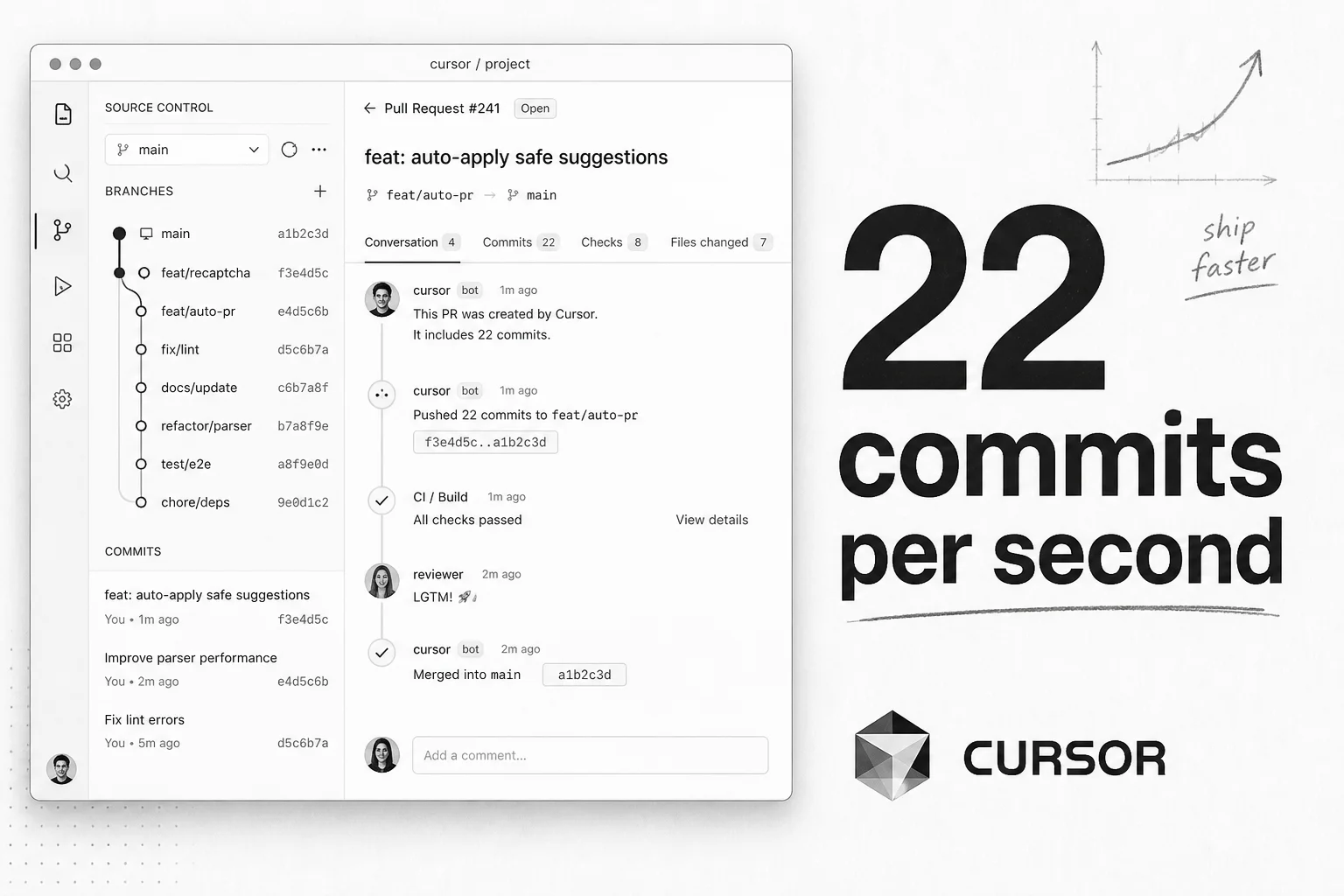
GitHub was built for humans opening one pull request at a time. Cursor's Compile keynote argued that assumption is cracking: cloud agents already merge a large share of changes inside Cursor, and throughput on a single repo can look nothing like a human sprint.
Origin is Cursor's answer. A git forge for the agentic era, announced June 16, 2026 at Compile in San Francisco, with a waitlist that reportedly hit its end-of-July target within 24 hours. The pitch is not "another remote." It is infrastructure where repositories, pull requests, review, and agents share one surface.
What Origin actually ships (and what is still demo)
Cursor first framed Origin as a fall 2026 release. Coverage since August 2026 describes an early beta on paid plans with repos, pull requests, code browsing, GitHub sync, and a Codebase tab inside the editor. Agent-native review features are still rolling out.
What was concrete at announcement:
| Layer | Status at Compile | Why it matters |
|---|---|---|
| Git-compatible hosting | Announced, beta since Aug 2026 | git push workflows stay familiar |
| Graphite DNA | Confirmed (Dec 2025 acquisition) | Stacked PRs and merge-queue thinking |
| Agent throughput demo | 22.6 commits/sec in one repo | Sets the design target, not your SLA |
| MCP and API extensibility | Promised | Agents drive the forge programmatically |
| GitHub coexistence | Beta docs emphasize sync | GitHub can stay source of truth initially |
The throughput numbers from stage deserve skepticism and attention at the same time. Cursor cited roughly 296,000 clones and 81,000 pushes in an hour on a single repository, plus 22.6 commits per second. Several write-ups confused clones per hour with clones per second. Treat every figure as a vendor benchmark until you reproduce it on your workload.
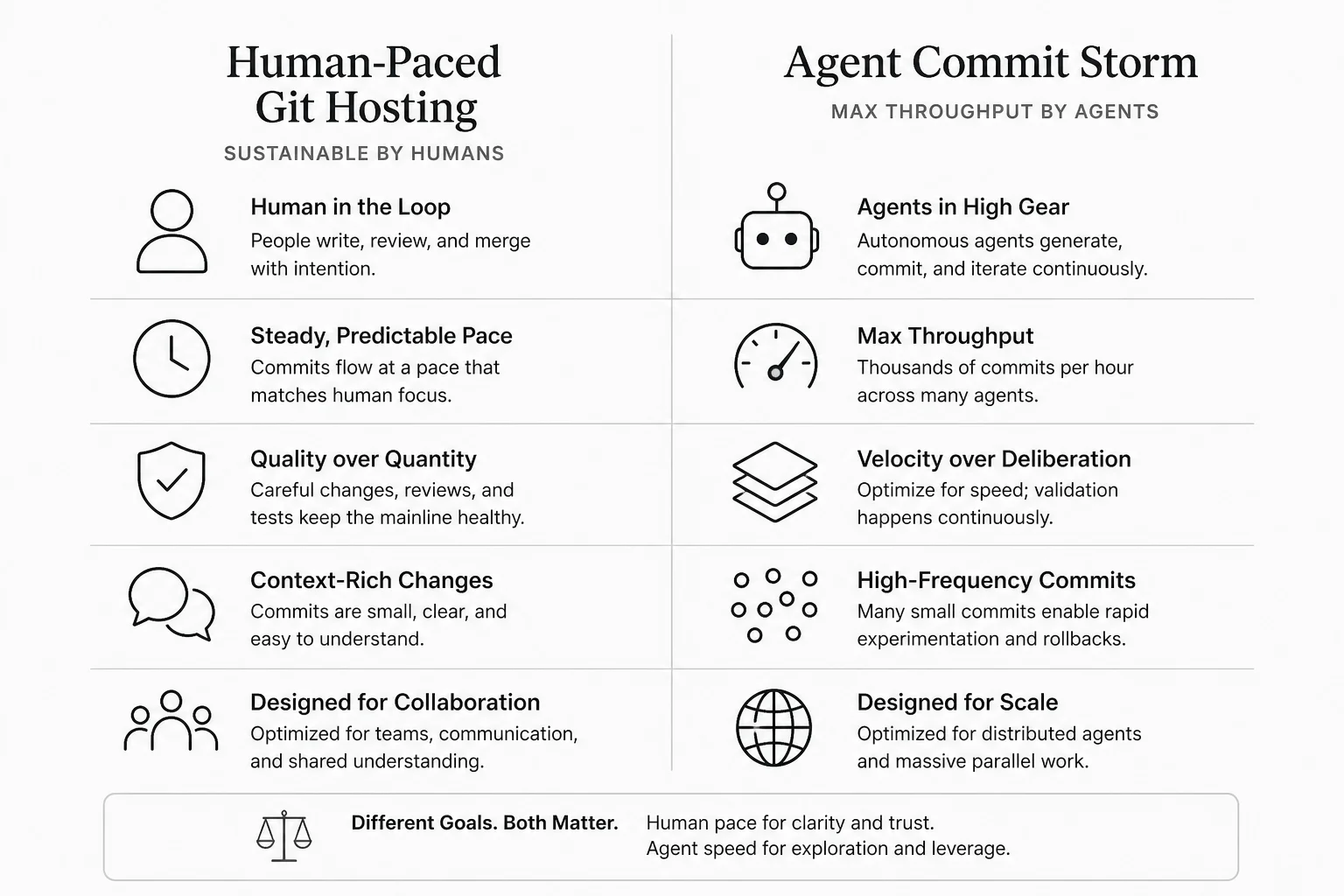
Why agents break the old forge model
RuntimeWire cited an internal Cursor figure that stuck with me: about 35% of pull requests merged inside Cursor were opened by agents running autonomously in cloud VMs. GitHub's Octoverse 2025 reported 43.2 million pull requests merged per month, up 23% year over year. A forge built for human intent assumes you can ask the author what they meant. When a third of merged changes come from software, the queue becomes scheduling, not conversation.
That is the architectural argument behind Origin:
- Volume: Many agents pushing branches in parallel on one codebase.
- Persistence: Agents that stay through review comments, CI failures, and merge conflicts instead of disappearing after opening a PR.
- Co-location: Code, diffs, checks, and the agent that wrote the patch in one product surface.
Graphite co-founder Merrill Lutsky, now building Origin inside Cursor, described the goal as "full self-driving PRs" that can reach production without a human touching every diff. Whether you want that end state or not, the infrastructure question is real.
The Graphite acquisition was the tell
Cursor acquired Graphite in December 2025. Graphite's core idea was stacked pull requests: ship dependent changes without waiting on serial approvals. Origin inherits that review philosophy and adds hosting underneath.
Before Graphite, Cursor owned the editor and cloud agents but rented the system of record from GitHub or GitLab. Origin closes the loop: write in Cursor, review with Graphite patterns, host on Origin.
Enterprise teams should read that as a procurement shift, not a feature toggle. Origin beta rolled out as opt-out on paid plans for many orgs, not opt-in. Administrators who missed that sentence may find a second remote appearing beside GitHub without a migration plan.
GitHub sync is the pragmatic path (for now)
Cursor's changelog and docs stress coexistence first. You can mirror GitHub repos into Origin while GitHub remains source of truth for repos that started there. Pull request conversations sync both ways: comment in Cursor, see it on GitHub; react on GitHub, see it in Cursor within seconds.
That lowers the risk for platform teams who want to measure whether an agent-native review surface shortens cycle time without touching branch protection rules yet.
The harder questions remain open on Origin-specific data terms: retention, training use, export, and deletion. Cursor became a wholly owned SpaceX subsidiary in August 2026. That does not make hosting unsafe by default, but it does change who your code custodian is if Origin becomes authoritative.
What I would test before moving anything important
If you are already on Cursor paid plans and the beta is available:
- Sync a non-critical repo with GitHub as source of truth. Measure review latency, not commit throughput demos.
- Run one cloud agent task that opens a PR on Origin and ask it to respond to a review comment in place. That workflow is the product thesis.
- Map your CI path: Vercel, Depot, and Buildkite integrations exist in docs; verify your GitHub Actions workflows on Origin-hosted repos before you depend on them.
- Document who can opt out: enterprise admins may need an explicit policy before agents get a second hosting surface.
The uncomfortable coincidence
Origin's public beta landed August 17, 2026, hours into a long GitHub degradation. Error rates near 20% on APIs and pull requests, Copilot SSO down with enterprise auth. Cursor almost certainly did not time that outage. The coincidence still dramatized the argument Origin exists to make: when the default forge wobbles under agent load, alternatives get interesting fast.
Matt Palmer from SpaceXAI noted on X that Cursor delayed shipping partly because GitHub was down and importing repos is a bad onboarding step when GitHub is down. Even Origin depends on a healthy GitHub for many teams today.
Bottom line
Origin is not a migration mandate yet. It is a bet that git hosting becomes a strategic choice again because agents changed commit volume and review shape. Cursor wants to own write, execute, review, and store in one stack.
For applied AI teams, the actionable read is narrower: measure whether your agent PRs are already bottlenecked on human review queues and forge limits. If they are, Origin (or Entire, or GitHub's own Agent HQ response) is worth a controlled pilot. If your agents still only open one PR a day, your bottleneck is probably prompt quality, not git infrastructure.
If you are wiring agent fleets into production repos and want a second opinion on review policy, CI, or where the system of record should live, book a free discovery call. I help teams ship agentic coding without turning the main branch into a merge lottery.